History of Downtown Kansas City
History of Downtown Kansas City
The Majestic and The History of Downtown Kansas City
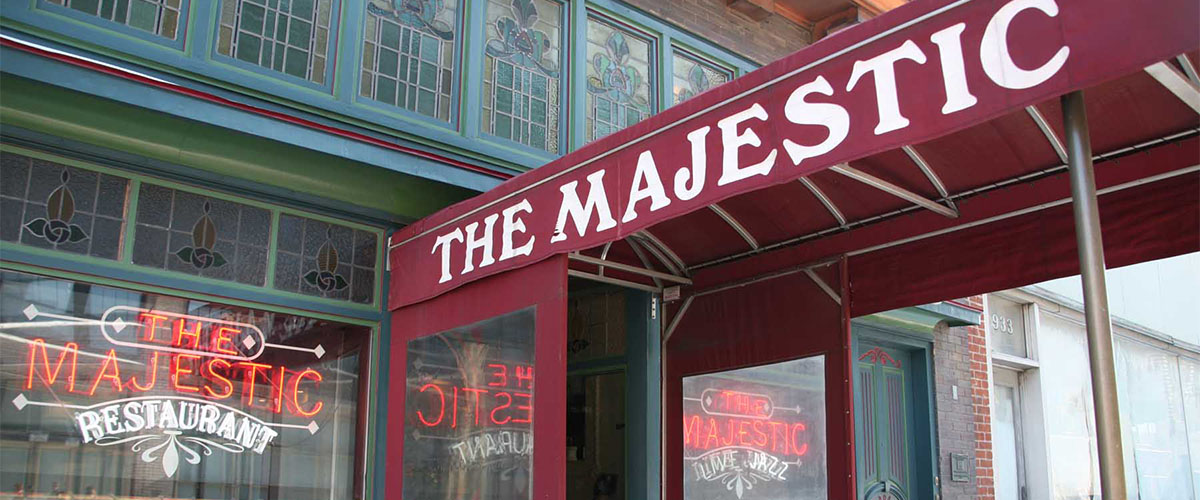
The Majestic Restaurant is housed in the Historic Fitzpatrick’s Saloon Building in downtown Kansas City. Over the last 100 years, this beautiful, old saloon building at 10th and Broadway has been at the epicenter of the growth of Kansas City and witnessed the tremendous contributions the city has made to American history. While most people know us as a classic Kansas City’s most authentic steakhouse, very few stop to consider how much of Kansas City’s history was seen just outside our front step.
From the flappers of the jazz era to a garment district second only to New York…
From the cowboys of the Wild West to the gangsters of prohibition…
From the first rail crossing of the Missouri River to the birth of Kansas City Bar B Que…
It all happened right outside our front door and chapters of this history are still being written at this classic Kansas City Steakhouse.
The area of downtown Kansas City where The Majestic Restaurant is located was covered in trees when a man named Kersey Coates arrived in town in 1854. At this time the tiny Town of Kansas was located near the Missouri River and primarily served as a point for steamships to unload supplies for the nearby town of Westport. Coates was sent from Pennsylvania by investors to look after a 100-acre parcel of land they bought that composed much of what is now considered downtown Kansas City. Disappointed in the mineral contents of the land, they ordered Coates to sell it in parcels to the locals. Instead, Coates bought the land himself and developed what became Kansas City’s first residential neighborhood. He called the area “Quality Hill” and built the original Kansas City Board of Trade Building (near 8th and Wyandotte), The Coates Opera House (across the street from The Majestic) and the Coates Hotel (at 10th and Broadway). Coates’ most significant contribution to the growth of Kansas City was the work he did with Kearney, Van Horn, and others to land the construction of the first railroad bridge across the Missouri River just nine blocks from The Majestic at the foot of Broadway Blvd.
50 years later, in 1911, a man named James A. Fitzpatrick decided to open a saloon in the Quality Hill neighborhood. With the support of “Big Jim” Pendergast and his brother “Boss Tom” Pendergast, he opened Fitzpatrick’s Saloon in the building that now houses The Majestic Restaurant. The first floor featured libations while the upper floors housed a notorious brothel as well as Fitzpatrick’s residence. When Prohibition became the law of the land in 1920, the saloon was moved to the lower floor that now serves as our Jazz Club. Due to his favorable relationship with Boss Tom, Mr Fitzpatrick was able to keep a very successful speakeasy throughout prohibition. This relationship also led to Boss Tom using the top floor of the building as a secondary office for his “business” meetings.
Around the same time that James Fitzpatrick entered the saloon business, another local entrepreneur set up shop. Henry Perry moved to Kansas City from Tennessee in 1907. Shortly thereafter he began selling smoked meat sandwiches to employees on their lunch breaks from an alley cart. Soon he would move his cart to the jazz district. When he died, he left his business to an associate named Charlie Bryant who would later sell it to his brother Arthur. Arthur Bryant’s became synonymous with Kansas City BBQ rivaled only by the shop opened by another of Perry’s employees, Arthur Pinkard. Pinkard went on to help George Gates open the legendary Gates and Son’s Bar-B-Q.
Something else was developing in Kansas City around this time. Historians say that jazz was born in New Orleans, but it grew up in Kansas City. Thirsty speakeasy patrons were eager to hear this new modern sound and great jazz performers flocked to Kansas City. With its 4/4 time and blues influenced 12 bar style, Kansas City jazz was influencing the nation. Musicians like Count Basie and Charlie Parker participated in all night jam sessions. Boss Tom Pendergast had the sweet sounds pouring into the streets knowing that keeping patrons entertained kept them drinking.
Fitzpatrick’s Saloon survived prohibition, but could not withstand Kansas City’s changing landscape. The area formerly known as Quality Hill became known as The Garment District. Fitzpatrick’s soon was converted to garment manufacturing as well. The Kansas City Garment District was surpassed only by New York in production. At one time it was estimated that one in six outer coats and one in seven women’s garments was produced in Kansas City’s Garment district. These garments could be found nationally or locally in department stores like the legendary Emery, Bird, and Thayer.
Not much is known of the Fitzpatrick’s Saloon Building during the middle part of the 20th Century. Like much of downtown, the building fell into disrepair. That would not last long. A rebirth was coming for downtown Kansas City and with it would come a new name for Fitzpatrick’s Saloon.
Continue the story with The History of The Majestic Restaurant.